
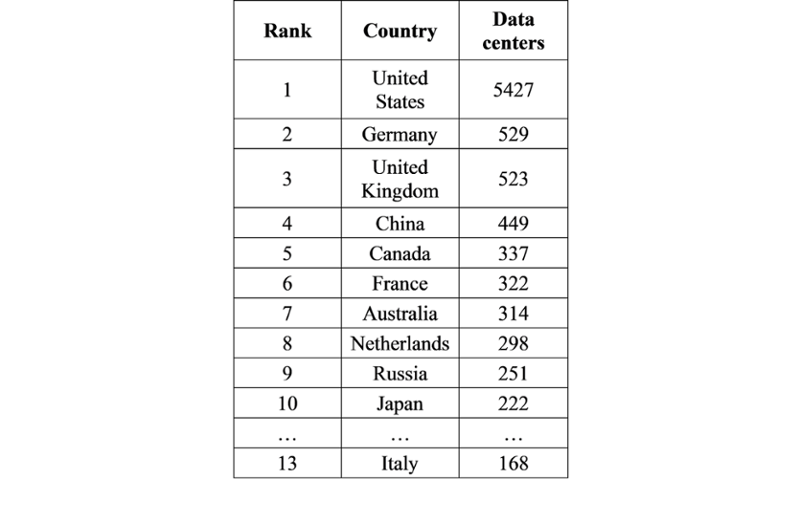
As of November 2025, the United States had 5,427 data centers, close to 45% of the roughly 12,000 worldwide and almost ten times more than any other country. Germany is next, with 529. Italy is thirteenth, with 168 and UK with 423. China, this time, only ranks fourth. The full ranking goes country by country.
Ranking of the world's largest datacenter owners
Source: Cargoson
Why the count misleads
A raw count treats every site as equal. A small colocation site and a hyperscale campus each score one. The real question is how much power sits behind the number.
Ireland is a good example. It has only 55 data centers, 28th on the list, but 18 are hyperscale, one of the highest shares in Europe. By the count it looks small. By the power it uses, it is a major hub, and its grid is under strain.
Ranking of the world's hyperscale data center owners

Source: Cargoson
The U.S. holds 54% of the world's roughly 1,189 hyperscale sites and about 44% of all installed capacity. The count shows where the buildings are. Capacity shows where the power goes.
The load behind it
The IEA put global data center use at about 415 TWh in 2024, near 1.5% of world demand, and sees it more than doubling to around 945 TWh by 2030. Most of the rise is AI, which draws far more power per server rack than earlier work.
From edge to power
For years, data centers were built close to their users. The work was serving websites and apps, where response time matters: the gap between a 20-millisecond reply and a one-second one is easy to feel, and being near the user kept it fast. Northern Virginia became the largest cluster in the world this way, and Europe's main hubs, Frankfurt, London, Amsterdam, Paris and Dublin, grew the same way.
AI works differently. Training a model does not care about distance, but it needs huge clusters of machines in one place, so a lot of power in one spot. Inference, the part that answers your questions, can run in smaller sites and does not have to be instant: a chatbot that takes a few seconds is normal. So these sites no longer need to sit next to users. They go where power is cheap and plentiful, and they are far bigger than before, from tens of megawatts to hundreds, and at the top end more than a gigawatt. The biggest recent U.S. builds are in rural areas, not city edges.
The limit on growth is no longer chips or money. It is power, and being able to connect to the grid.
Italy's grid queue
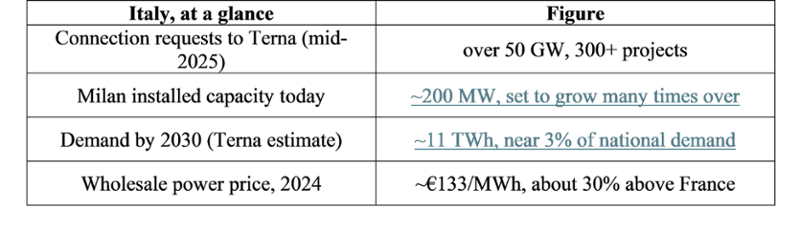
Several of the old hubs are now running short of grid capacity and water, so the next wave is moving to where land and power are easier to get. Italy is one of those places, and the shift has been quick. By mid-2025, Terna had received connection requests above 50 GW across 300-plus projects, up from about 30 GW six months earlier and 24 times the 2021 level. Most of it is in the north, with Lombardy at the center.
Key data on the data center sector in Italy
Source: Cargoson
Two things make Italy a useful case. First, price: Italian wholesale power averaged about €133/MWh in 2024, near 30% above France, and that cost decides where a project is worth building. Second, the grid is the limit, not the buildings. Connection waits run to years, and Terna now screens real projects from speculative ones, so much of that 50 GW will never be built. It has set aside more than €16 billion to strengthen the grid.
What it means for Italy
The least harmful projects go where power would otherwise be wasted, next to wind or solar plants the grid cannot fully carry away, and use closed-loop cooling that draws almost no local water. That approach is not yet standard, but it is already in use.
Italy has gone from a minor player to a serious hub in three years. Whether that becomes 11 TWh of well-placed demand, or projects that get permits but never get connected, depends on grid build-out, honest screening, and where the power comes from. The count says 168 today; the energy map will decide how many announced sites become real, and at what cost to the system around them.