The Middle East crisis has dealt a major supply shock to global natural gas markets. The gradual easing in market balances that had been underway since the second half of 2025 was significantly disrupted by the de facto closure of the Strait of Hormuz following the outbreak of the war in the Middle East at the end of February 2026. The disruption of liquefied natural gas (LNG) flows through the Strait – which had accounted for almost 20% of global LNG supply – has resulted in strong price volatility.
Natural gas supply from Middle Eastern producers has plunged in 2026, but other suppliers have stepped up. Between March and August, LNG loadings from Qatar and the United Arab Emirates declined by more than 50 billion cubic metres (bcm) year-on-year – a reduction equal to over 80% of Italy’s annual natural gas consumption in 2025. However, this steep decline was partially offset by higher LNG output from new projects in North America and Africa and the improved availability of feedgas supply from legacy producers in Africa and Asia. During this period, non-Gulf LNG production grew by around 15% (or around 35 bcm) year-on-year, offsetting around two-thirds of the decline in Gulf LNG deliveries. Altogether, global LNG production fell by around 6% (or 17 bcm year-on-year) from March to August.
Year-on-year decline in LNG loadings from Qatar and the United Arab Emirates compared

Source: IEA analysis based on ICIS (2026), LNGEdge
To help fill the gaps, exporters have adopted measures aimed at boosting LNG supply. In March, the US government authorized the Plaquemines LNG plant to increase its exports by 13% (or 4.6 bcm/year) to both free trade and non-free trade agreement countries. The Elba Island LNG plant was authorized in early April to increase its exports by 22% (or 0.8 bcm) to non-free trade agreement countries.
Natural gas prices across European gas hubs reacted swiftly to the supply disruption caused by the effective closure of the Strait of Hormuz. Prices on the most liquid European gas hub, the Dutch Title Transfer Facility (TTF), rose by more than 40% y-o-y to an average of over EUR 50/MWh (or USD 17.3/MBtu) through March-August 2026 – their highest seasonal level since 2022. The steep decline in LNG inflows into Europe, down by more than 10% y-o-y, provided strong upward pressure on natural gas prices. The market uncertainty created by the sudden loss of almost 20% of global LNG supply supported strong short-term price variability. TTF month-ahead price volatility averaged close to 85% through March-August 2026, standing almost 40% above its ten-year average.
Other European gas hubs displayed similar price dynamics and continued to show a strong correlation with TTF, despite the elevated volatility. In Italy, natural gas hub prices on the Punto di Scambio Virtuale (PSV) rose by almost 40% y-o-y to an average of EUR 53/MWh (USD 17.9/MBtu) through March-August 2026. The correlation between TTF and PSV stood at 0.99 during this period, highlighting the intertwined nature of the European gas market. PSV’s premium compared to TTF has averaged at almost EUR 2/MWh (USD 0.6/MBtu) since the beginning of March, reflecting the higher procurement costs of Italian importers, including via the North-to-South pipeline corridors.
Percentage change in TTF and PSV month-ahead prices compared with 27 February 2026, March-August 2026
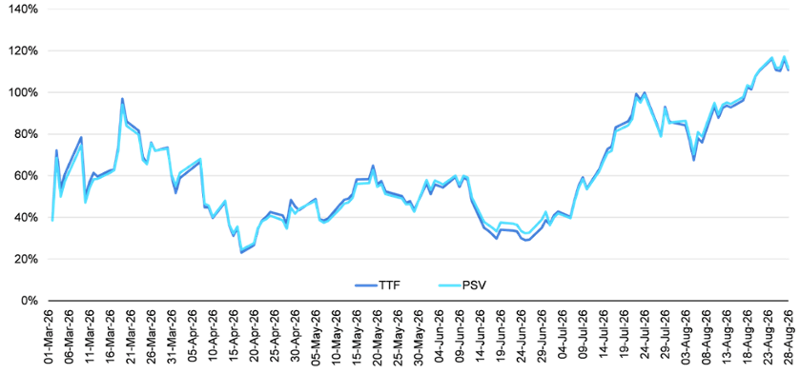
Sources: IEA analysis based on ICE (2026), Dutch TTF Natural Gas Futures and Italian PSV Natural Gas Futures.
In Asia, Platts JKM prices followed a similar trajectory. Asian spot LNG prices rose by 55% y-o-y to an average of over USD 19/MBtu during the March-August period, their highest seasonal level since 2022. Asian spot LNG traded at a premium of USD 2/MBtu compared to European hub prices during the March-July period. This supported a diversion of flexible LNG cargoes from Europe to Asian markets, which are more directly affected by the closure of the Strait of Hormuz. The spread narrowed to below USD 1/MBtu in August, which could potentially support a recovery of Europe’s LNG imports.
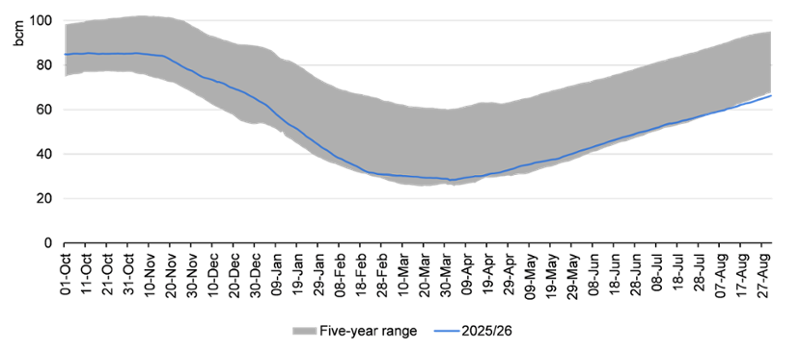
Despite the strong increase in natural gas prices, gas-fired power generation increased by around 15% y-o-y in the European Union through the May-August period. Higher cooling demand together with lower hydro and nuclear power generation increased the call on gas-fired power plants, which provided back-up to the European power system and ensured electricity supply security during summer heatwaves. Tight LNG supply, together with higher gas-to-power demand, kept European spot prices at a premium compared to winter forward contracts. Seasonal price spreads on TTF averaged EUR -1.5/MWh (USD 0.5/MBtu) during the April-August period. This reduced the commercial incentive for underground storage filling. Storage injections stood 10% (or 4.5 bcm) below their five-year average during the April-August period. Consequently, the deficit of the EU inventory levels compared to their five-year average grew to over 17 bcm by the end of August.
Underground storage levels in the European Union, 2021/22 – 2025/26
Source: IEA analysis based on AGSI (2026), Aggregated Gas Storage Inventory
If the rate of EU storage injections now returns to its five-year average, EU storage sites would be filled to below 75 bcm by 1st November - which would be their lowest fill level since 2013. These lower inventory levels could necessitate stronger LNG imports through the 2026/27 winter to meet higher seasonal natural gas demand. This in turn could intensify competition with Asian buyers for flexible LNG cargoes.
The continued disruption of LNG flows via the Strait of Hormuz increases the risk that Gulf LNG exports will not recover significantly before Q4 2026. Depending on the duration and extent of disruptions to LNG flows via the Strait of Hormuz in the coming months, global LNG trade could record its first annual decline since 2012. A prolonged disruption would increase the risk of heightened gas price volatility through the 2026/27 heating season. In an increasingly complex geopolitical context, strengthening the architecture of global gas supply security requires closer international cooperation, including between producers and consumers. The International Energy Agency supports this dialogue through its Gas Working Party and the LNG Producer-Consumer Conference, organised jointly with Japan’s Ministry of Economy, Trade and Industry in Tokyo on September 11.