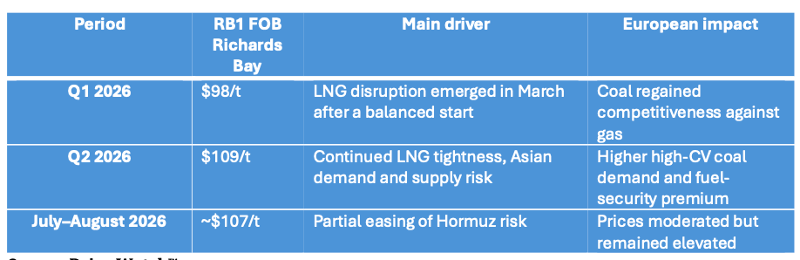
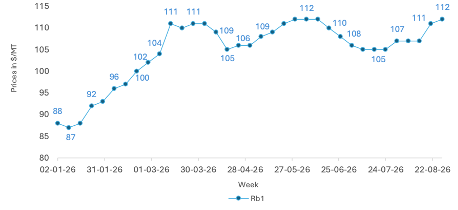
Thermal coal returned to the energy agenda in 2026, not as a reversal of the energy transition, but as a hedge against volatile LNG and gas markets. South African RB1 Coal, a premium export-grade thermal coal benchmark, averaged around $98/t FOB Richards Bay in Q1 2026, increased to $109/t in Q2, and eased to $107/t in July–August as the geopolitical premium began to fade.For Europe, the importance of coal does not l ie in a broad recovery in consumption. Coal-fired capacity continues to shrink, but the remaining capacity gains more value when LNG is scarce, TTF prices rise (TTF is a European pipeline-gas and wholesale-gas benchmark), renewable output is weak or power demand accelerates.
LNG Disruption Changed Coal and Gas Prices
At the start of 2026, energy markets expected a more comfortable LNG balance as new capacity, particularly from North America, increased supply. Europe was expected to raise LNG imports as it continued replacing declining Russian pipeline gas with seaborne volumes.
However, the energy outlook changed drastically in March 2026. Disruption through the Strait of Hormuz constrained LNG exports from Qatar and the United Arab Emirates. Hormuz is not a major coal route, but it affects coal prices through fuel substitution: lower LNG availability tightens gas markets, higher gas prices increase gas-fired generation costs, and coal becomes more competitive where coal-fired plants remain operational.
The International Energy Agency (IEA) estimates that LNG loadings from Qatar and the UAE fell by around 35 billion cubic metres (bcm) year on year between March and June 2026. Supply growth from North America, Africa and other producers partly offset the disruption, but global LNG production still declined by around 4%.
This restored the energy-security value of high-CV coal. RB1 coal became more attractive because it provides more energy per tonne, supports power-plant efficiency, and can replace expensive gas-fired generation where coal-capable systems remain available.
RB1, API2 and TTF in the European Coal Market
For European buyers, RB1 coal is not the final purchasing benchmark. RB1 coal is quoted FOB Richards Bay, representing the South African export value at the loading port. The key European reference is API2 CIF ARA-the delivered thermal-coal
benchmark for Amsterdam, Rotterdam and Antwerp. API2 coal benchmark incorporates ocean freight, insurance and Atlantic Basin supply-demand conditions.
The RB1-API2 coal spread therefore matters. Rising South African coal FOB prices combined with higher freight rates can push the delivered cost into Europe materially above the RB1 price. Conversely, increased Colombian or US coal supply can cap API2 coal prices even when Richards Bay prices remain firm.
Utilities compare API2 coal with TTF gas and EU carbon allowances when assessing whether coal or gas is more competitive. Coal emits more carbon dioxide per MWh than gas and therefore carries a higher carbon cost under the EU Emissions Trading System (EU ETS). However, when TTF rises sharply relative to API2, coal can regain merit-order competitiveness despite this carbon disadvantage. This dynamic was firmly visible in the first-half of 2026.
RB1 Price Development Through 2026
Source: Price Watch™
March 2026 Marks the Market Inflection Point
Q1 2026 started with a balanced thermal-coal market as improving LNG availability and stronger renewable generation reduced pressure on European gas and coal demand. However, the balance changed in March 2026 when Strait of Hormuz disruption reduced Gulf LNG supply. TTF and Asian LNG prices strengthened sharply, flexible cargoes became more contested, and gas-fired generation became more expensive.
Coal plants regained competitiveness where capacity remained available. RB1 benefited more than lower-CV grades because its higher heat value supports better efficiency which makes it a more effective gas substitute. The $98/t average therefore combines a softer start with a much firmer end to the first quarter.
Thermal Coal Prices RB1, FOB Richards Bay, South Africa, 2026
Source: Price Watch™
Q2 2026 Brings Stronger Coal Market Fundamentals
RB1 coal prices reached about $109/t FOB Richards Bay in Q2 as LNG disruption persisted. Higher European gas and electricity prices increased the value of fuel flexibility. Asian coal-market fundamentals reinforced the seaborne market. Chinese mine-safety inspections restricted domestic supply, while summer cooling demand raised electricity consumption and coal imports. Furthermore, Indonesia, one of the world’s major coal producers, also added uncertainty through lower production and changing export administration. As Indonesia is a major supplier of low-CV coal to Asia, buyers sought alternative supply, supporting demand for South African RB1 cargoes.
However, Transnet rail disruptions added a supply-risk premium at Richards Bay port. Even when port inventories avoided immediate shortfalls, uncertainty over export reliability supported FOB prices and, through freight, raised European delivered coal costs.
Coal Retains Strategic Value Despite the Energy Transition
Europe is not entering a long-term coal revival. Renewable deployment, coal-plant closures and carbon policy will continue to reduce annual coal demand. However, the remaining coal plants retain strategic importance during low wind periods, weak hydro output, nuclear outages, severe weather or delayed LNG cargoes. However, this exposure is unevenly distributed across Europe. Germany and Poland retain more coal capacity than much of Western Europe, while the UK’s coal role has been minimal.
Coal-price sensitivity is therefore concentrated in markets where coal generation remains available.
RB1 offers high-CV efficiency and blending flexibility, API2 provides the delivered-cost reference against which European utilities assess coal-to-gas switching. Their significance in 2026 has been assessed more tactical rather than structural.
Regional Demand Dynamics and European Market Exposure
The near-term coal outlook remains volatile but broadly supportive. Key variables include Hormuz transit, Gulf LNG recovery, European gas storage, Asian LNG demand, weather, renewable output and Transnet rail reliability. Asia should continue to provide a floor for seaborne coal demand. China’s industrial activity, cooling requirements, EV charging and data-centre growth support electricity consumption, while India and Southeast Asia remain substantial coal consumers. Yet coal buyers remain price-sensitive and could draw down inventories, favour domestic production or switch to lower-CV coal if prices rise sharply.
For Europe, LNG remains vital but contested. If Asian LNG prices exceed TTF, flexible cargoes may move east, tightening European gas availability. Meanwhile, the TTF-API2 relationship will remain a key determinant of whether coal or gas is more competitive in the power-generation stack. The base case is a European winter defined by fuel flexibility rather than outright physical shortage. RB1 and API2 coal should retain support as insurance against LNG disruption, weak renewable generation and power-market stress. A bullish outcome for coal would require renewed Hormuz disruption, weak wind and hydro output, low European gas storage, strong Asian LNG demand or additional Transnet interruptions. Conversely, a bearish scenario would involve normal Gulf LNG flows, strong North American supply, healthy European gas inventories and favourable renewable output.
Europe’s thermal-coal market is becoming smaller but more sensitive. Coal will not return as Europe’s dominant fuel, but it remains valuable during periods of energy stress. European buyers should manage RB1, API2, LNG procurement, TTF exposure, EU carbon costs and renewable-output risk as part of an integrated energy-security matrix.